




Employee engagement explained
How many of your people are truly engaged in their work? Even if your organisation is achieving average levels of employee engagement, it could be as low as one in eight, according to the research firm Gallup. Imagine that: Seven out of every eight of your colleagues not contributing fully to the organisation’s success. It’s frightening.
What is employee engagement and why does it matter?
We all know when we’re engaged in our work and we recognise it in our colleagues. One good definition is that employee engagement is “being positively present during the performance of work by willingly contributing intellectual effort, experiencing positive emotions and meaningful connections to other”. It’s characterised by feeling positively about a job, working hard to do the job well and feeling loyalty towards colleagues and to the organisation itself.
All the research shows that engagement matters. As just one example, the Institute for Employment Studies reports that engaged employees deliver four times more value to an organisation than those who are disengaged. Engaged employees go the extra mile – even when times are tough.
Internal communication: Key driver of employee engagement
You can turn the dial on employee engagement in a number of ways. In particular, improving the general management capabilities of line managers can be crucial. Employees’ relationship with their immediate supervisor is the major contributor to their level of engagement.
The other big lever you can use is internal communication. Effective communication with employees enables you to:
- get employees to buy into company strategy and major change
- increase belief in senior leaders
- drive up pride in the organisation
- encourage innovation and collaboration
- motivate employees to maximise their contribution towards company goals.
Indeed, as Gallup tells us: “Regular communication from the company’s leaders and informal communication between employees will begin to breed a culture of engagement, leading participation rates of employee engagement metrics and other interventions to be more successful.”
Using internal communication to drive up employee engagement
Axiom has nearly 20 years’ experience working with major organisations around the world to use internal communication to drive employee engagement.
Fundamentally, the challenge is about creating a ‘golden thread’ (or ‘red thread’ depending where you are in the world) that connects and aligns the actions of everyone in the business – from the girl in the stores and the guy on reception through to the leaders and their master plan. Employee engagement depends on creating total clarity about what the organisation is trying to achieve – and how people can contribute.
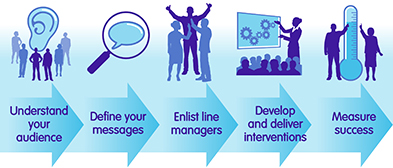
Major steps in devising an effective internal communication programme that will drive up engagement:
1. Understand your people
The better you understand the people you are communicating to, the more likely you are to be able to accurately target your messages and engage people in what you are trying to achieve. Put yourself in the shoes of your audience and ask: What do they want or need to know? Why do they want to know it? What might motivate or engage them? What won’t work?
2. Identify and define your messages
Decide what you want people to think, feel and do differently. Make that the basis of your key messages.
In particular, remember the importance of the ‘why’ in engagement – context is key. Employees often have a fair idea of content – in other words, ‘what’ they are supposed to do. It’s just that they have no idea why! Context is key. As part of this, make sure you appeal to people’s self-interest. Your messages must answer employees’ fundamental question: What’s in it for me?
Aim for between three and five key messages; any more, and people will struggle to see the wood for the trees.
3. Enlist and upskill line managers
Time and again, employees say that their line manager is their communication channel of choice, especially in times of change. The extent of their engagement depends on line managers. You need to upskill your managers so they can communicate with verve (especially face to face), act as positive role models and truly own the messages they are delivering.
4. Develop powerful interventions
Now (and only now) it’s time to start developing a clear plan for how you will make use of a range of communication activities or solutions. This can range from conferences and events to employee magazines and from internal social media to podcasts. The key thing is to create solutions that seize people’s attention, get them involved and encourage them to think and act differently.
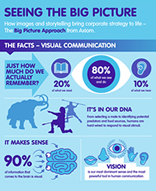
One of the best ways of doing this is by exploiting the power of images and storytelling to make a strategy or change convincing and meaningful. This is the essence of our Big Picture approach – a highly successful technique to turn your strategic aspirations into concrete reality. A Big Picture is a visual analogy for the journey your organisation has embarked on. It exploits the power of images and storytelling to make your strategy convincing and meaningful. It acts as a catalyst for discussions in which senior leadership and local work teams identify and explore what they need to do to contribute and commit to action.
5. Check you’re getting through
It’s all very well delivering shiny new communications solutions, but are they making a difference? Are you getting the results you’re looking for, or just moving a lot of hot air? You need to measure whether messages have been received, believed and understood and, ultimately, acted on. If not, you need to do something different.

Internal communication training
We've delivered our highly regarded internal communication training workshops to hundreds of delegates worldwide in companies including AstraZeneca, The Co-operative Group, Kingfisher and United Utilities.
Find out more
© Copyright . Axiom Communications (UK) Ltd. All rights reserved.